7-Day Crash Plan

If your interview is coming soon, you do not have time to learn everything.
This 7-day plan focuses on the highest-value topics and the most common interview moves.
Who this plan is for
Use this plan if:
- your system design interview is within one week,
- you have some software engineering experience,
- you do not feel fully prepared,
- and you need a focused plan instead of a long course.
This is not a perfect plan. It is a survival plan.
The goal is to help you become clear, structured, and ready for common follow-up questions.
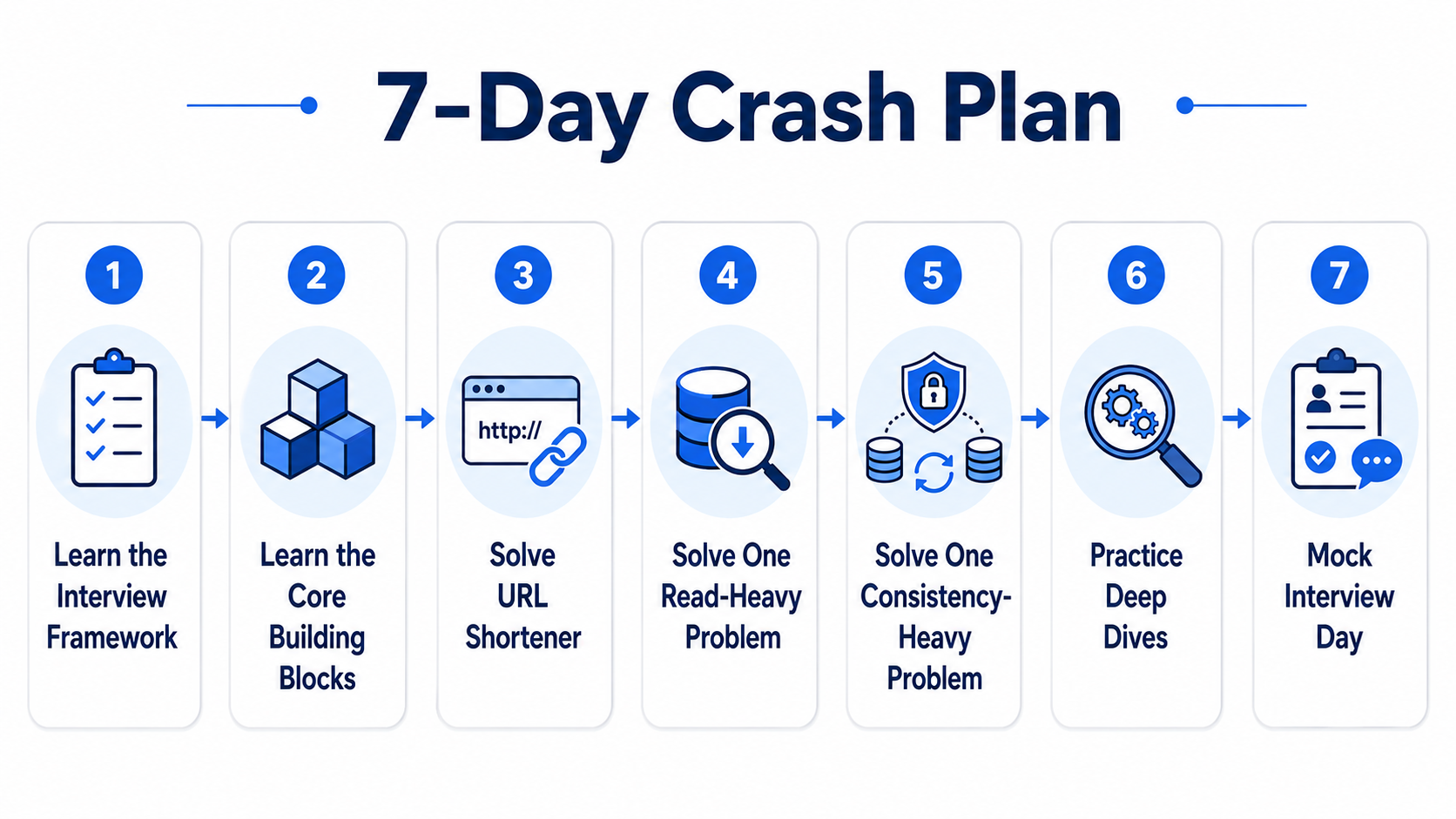
Day 1: Learn the interview framework
Focus on the process.
Read:
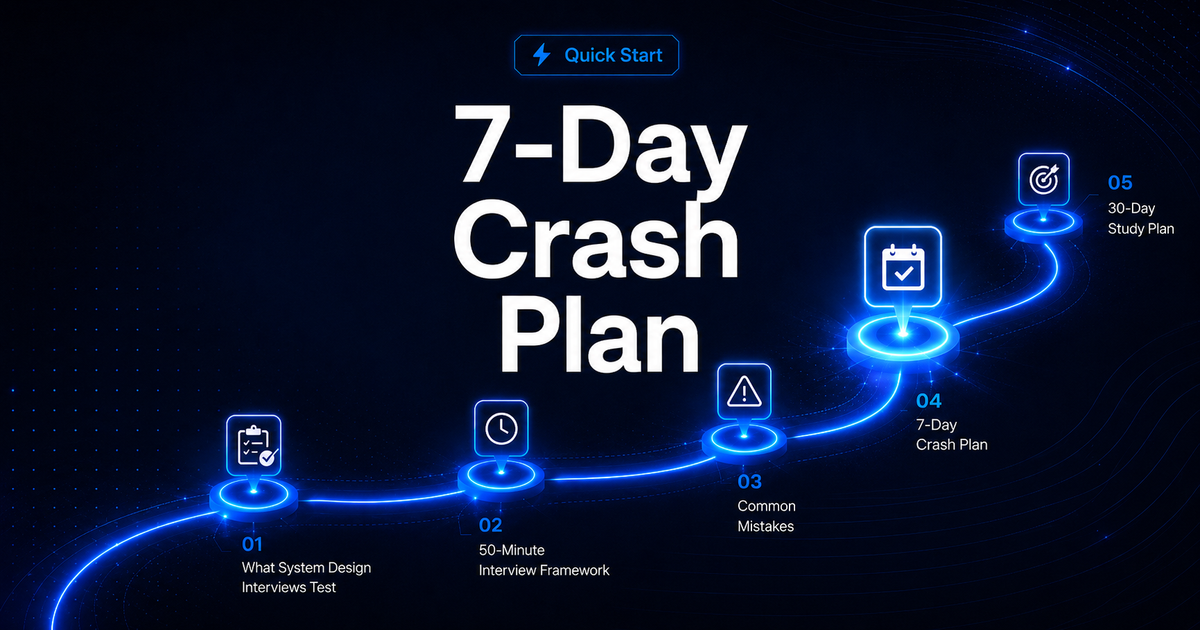
- What System Design Interviews Test
- 50-Minute Interview Framework
- Common Mistakes
Your goal is to be able to explain the interview flow:
Requirements → APIs → High-Level Design → Deep Dives → Wrap-up
Practice out loud for 15 minutes.
Prompt:
Design a URL shortener.
Do not solve the full problem yet. Just practice the opening:
- Ask clarifying questions.
- Define scope.
- State the main requirements.
Day 2: Learn the core building blocks
Focus on the most common components.
Study:
- Database
- Cache
- CDN
- Message Queue
- Blob Storage
- API Gateway
- Elasticsearch
Do not go too deep.
For each component, answer three questions:
- What problem does it solve?
- When would I use it in an interview?
- What tradeoff should I mention?
Example:
Cache
Problem: database reads are too slow or too expensive.
Use when: read traffic is high and some data can be reused.
Tradeoff: stale data and invalidation complexity.
Day 3: Solve URL Shortener
Do one full problem walkthrough.
Focus on:
- requirements,
- API design,
- data model,
- simple high-level design,
- uniqueness,
- caching,
- scale.
After reading, close the article and explain the design out loud.
Use this structure:
First, I would clarify...
Then I would define...
For the high-level design...
The first deep dive is...
The main tradeoff is...
Record yourself if possible. Listening to your own answer is uncomfortable, but very useful.
Day 4: Solve one read-heavy problem
Pick one:
- News Feed
- Yelp / Nearby Search
- URL Shortener again, but deeper
Focus on read traffic.
Key ideas:
- cache,
- read replicas,
- denormalization,
- search index,
- fanout,
- ranking,
- pagination.
Do not try to memorize a full answer.
Instead, learn the pattern:
If reads are much higher than writes, optimize the read path.
Day 5: Solve one consistency-heavy problem
Pick one:
- Ticket Booking
- Food Delivery
- Inventory System
- Review System with Voting
Focus on write conflicts.
Key ideas:
- optimistic locking,
- pessimistic locking,
- distributed lock,
- idempotency,
- reservation with expiration,
- database transaction.
Practice this phrase:
The main risk here is two users modifying the same resource at the same time, so we need a clear concurrency control strategy.
Day 6: Practice deep dives
Do not learn a new problem today.
Instead, practice follow-up questions.
Common questions:
- How would you scale this to 100M users?
- What happens if the cache goes down?
- How do you avoid duplicate writes?
- How do you handle hot keys?
- How do you handle retries?
- What data can be eventually consistent?
- What would you monitor?
For each question, use this format:
Problem → Option A → Option B → Tradeoff → My choice
Day 7: Mock interview day
Do one full 50-minute mock.
Use a timer.
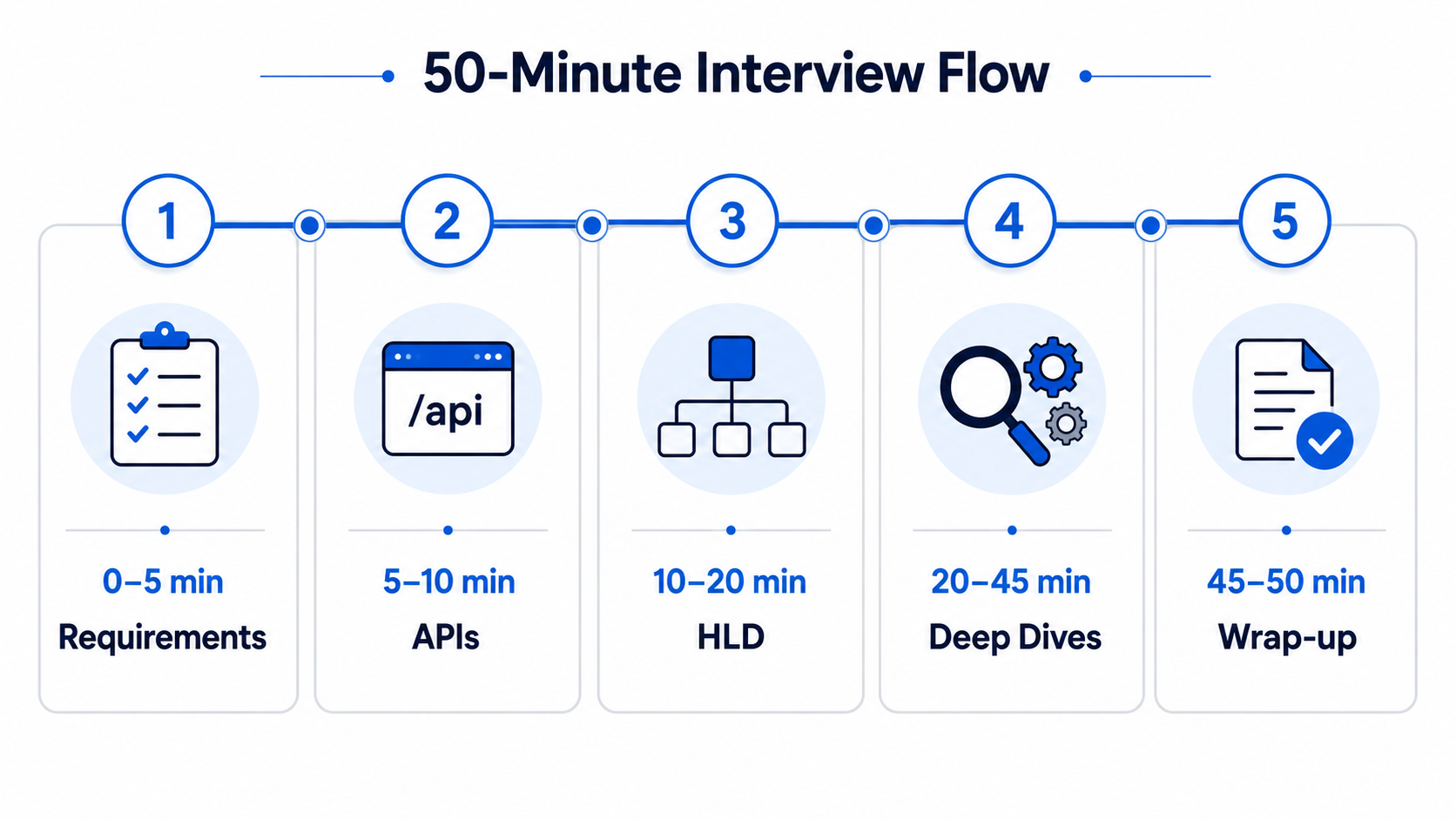
Recommended flow:
After the mock, review only three things:
- Was my structure clear?
- Did I explain tradeoffs?
- Did I reach deep dive early enough?
Final takeaway
In seven days, you cannot master all of system design.
But you can become much better at the interview format.
Focus on:
- structure,
- common components,
- 2–3 representative problems,
- clear tradeoff language,
- and speaking practice.
That is enough to improve your interview performance quickly.