Top K Frequent Elements
On this page
Problem statement
Given an array of integers and a number k, return the k values that occur most often. The answer is guaranteed to be unique, and it can be returned in any order. Aim for better than O(n log n).
It combines two patterns you'll use constantly: count with a hash map, then select the top k, either with a heap or, faster, with buckets indexed by count. Original problem: LeetCode 347.
Example
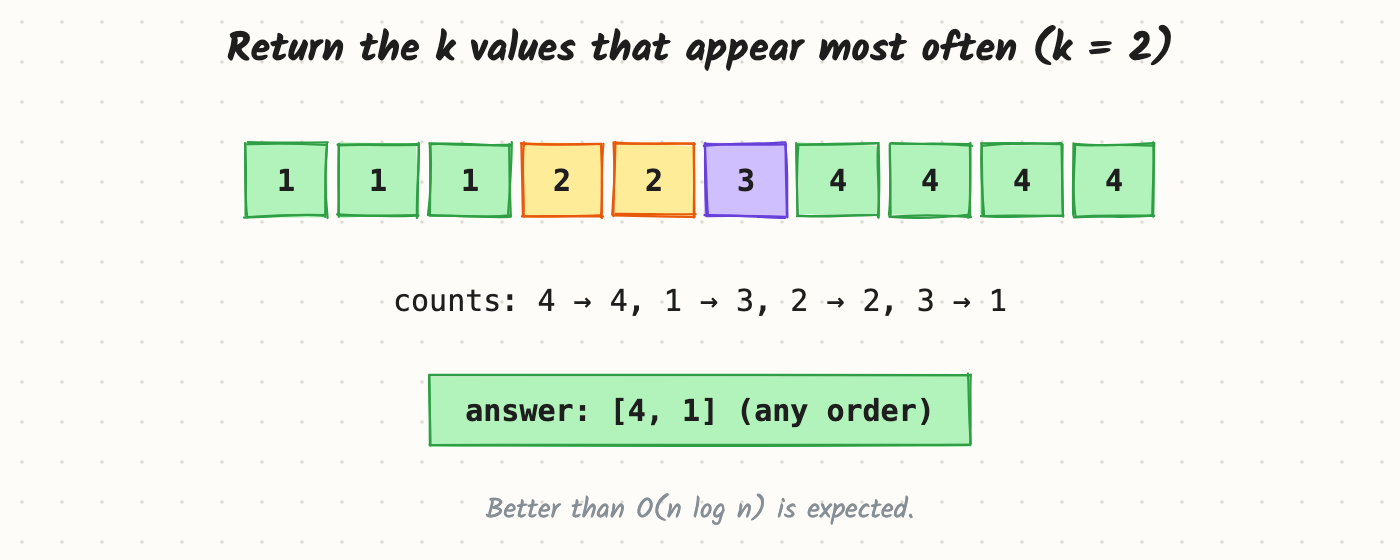
Input:  nums = [1, 1, 1, 2, 2, 3, 4, 4, 4, 4], k = 2
Output: [4, 1]       # any order
Input: nums = [7], k = 1
Output: [7]Constraints (assumed)
- 1 ≤ n ≤ 100,000; k is between 1 and the number of distinct values.
- The top k is unique (no tie at the boundary).
What this question tests
- Counting with a hash map.
- Selecting the top k without sorting everything.
- Spotting that counts are bounded by n, which allows bucket sort.
Questions to ask first
- Any order in the output? (Here: yes.)
- What if several values tie at the k-th place? (Here: it can't happen. If it could, ask which to return.)
- Is k small relative to the number of distinct values? A size-k heap is great when k is small.
- Is the input a stream? Then you'd keep counts and a structure updated incrementally.
Try it yourself first
You have the full problem. Sketch your answer, then sign up free to read the complete walkthrough.
- The complete design, flow by flow, with pictures
- Deep dives into the hard parts
- What mid, senior and staff candidates are expected to say
- Full company question lists
Free forever. No card needed.