Design Spreadsheet
On this page
Problem statement
Build a small spreadsheet engine. Cells are named like
A1orC7.set(cell, text)stores either a number ("12") or a formula that adds cells and numbers ("=A1+B1+5").get(cell)returns the cell's current value; an empty cell is 0. When a cell changes, every formula that depends on it, directly or through other formulas, must show the new value. Asetthat would make a cell depend on itself is rejected and changes nothing.
This is a favourite "machine coding" round: it starts as string parsing and quickly becomes a graph problem. Interviewers usually run it in levels: values first, then formulas, then updates that ripple through dependents, then cycle detection. The plain one-level version is LeetCode 3484; the dependency levels below are what makes it a real interview question.
Example
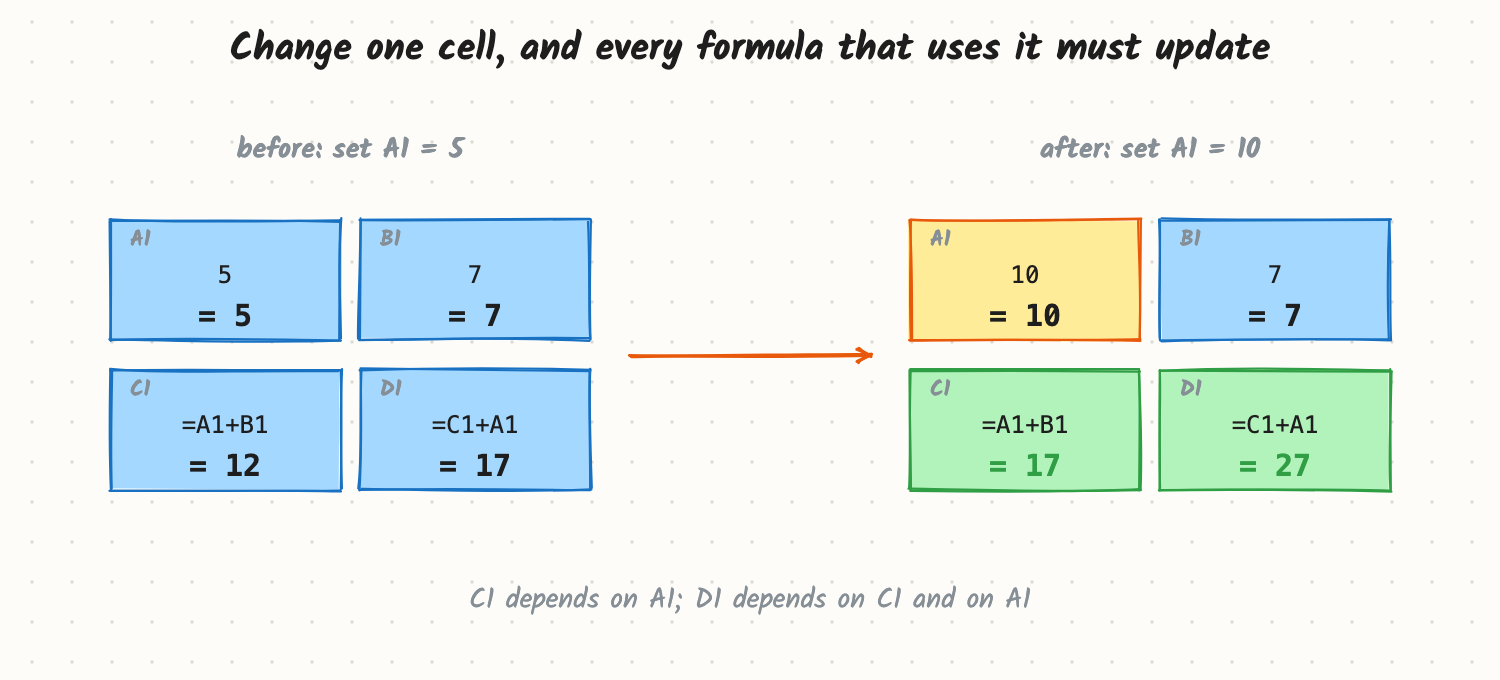
set("A1", "5");  set("B1", "7")
set("C1", "=A1+B1")      get("C1") -> 12
set("D1", "=C1+A1")      get("D1") -> 17
set("A1", "10")          get("C1") -> 17, get("D1") -> 27
set("C1", "=D1")         rejected: C1 -> D1 -> C1 is a cycle
get("Z9")                -> 0      # never set
Constraints (assumed)
- Up to 10⁴ cells and 10⁴ operations; a formula mentions at most a few dozen cells.
- Formulas use only
+of cell names and integers (other operators are a follow-up). - Reads are much more frequent than writes.
What this question tests
- Seeing the cells as a directed graph: an edge from A1 to C1 means "C1 reads A1".
- Updating dependents in topological order, so each cell is recomputed after everything it reads.
- Cycle detection before a write is committed, and clean class design you can extend level by level.
Questions to ask first
- What can a formula contain? (Here: cell names and integers joined by
+.) - What does an empty or never-set cell count as? (Here: 0.)
- What should happen on a cycle? Reject the write, or store it and show an error value? (Here: reject, nothing changes.)
- Reads or writes, which are more frequent? That decides between computing on read and computing on write.
Try it yourself first
You have the full problem. Sketch your answer, then sign up free to read the complete walkthrough.
- The complete design, flow by flow, with pictures
- Deep dives into the hard parts
- What mid, senior and staff candidates are expected to say
- Full company question lists
Free forever. No card needed.