Daily Temperatures
On this page
Problem statement
Given a list of daily temperatures, return for each day how many days you must wait for a strictly warmer day. If no warmer day comes later, the answer for that day is 0.
The cleanest introduction to the monotonic stack, the tool for every "next greater element" question: next higher price, next taller building, next larger number. Original problem: LeetCode 739.
Example
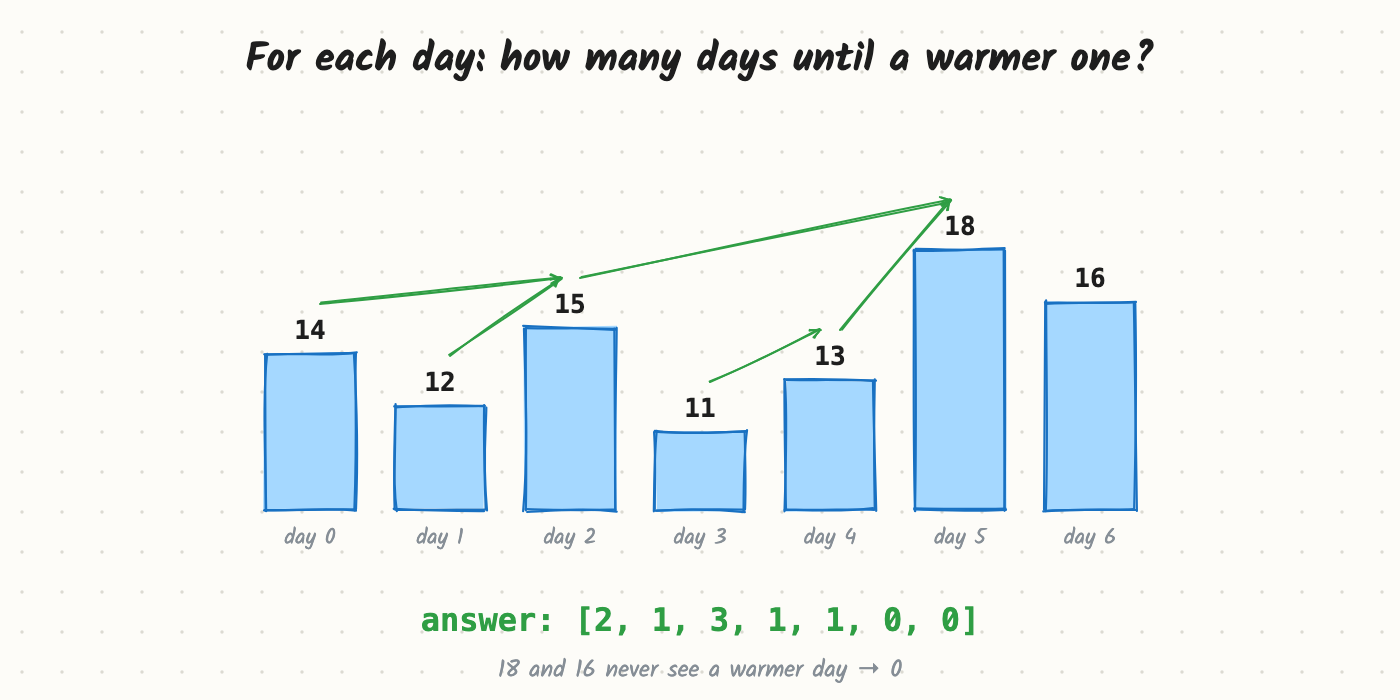
Input:  [14, 12, 15, 11, 13, 18, 16]
Output: [2, 1, 3, 1, 1, 0, 0]
Input: [5, 5, 6]
Output: [2, 1, 0] # an equal temperature is not warmerConstraints (assumed)
- 1 ≤ n ≤ 10⁵ days.
- Temperatures are integers in a small range (say 30 to 100 in Fahrenheit).
What this question tests
- Recognising a "next greater element" question and reaching for a monotonic stack.
- The amortised argument: each index is pushed and popped at most once, so the nested loop is still O(n).
- Storing indices, not values, so you can compute distances.
Questions to ask first
- Does an equal temperature count as warmer? (Here: no, strictly warmer.)
- What if no warmer day exists? (Here: 0.)
- How large is n? O(n²) is fine for 100 days, not for 10⁵.
- What is the temperature range? A small range allows a different O(n · range) trick.
Try it yourself first
You have the full problem. Sketch your answer, then sign up free to read the complete walkthrough.
- The complete design, flow by flow, with pictures
- Deep dives into the hard parts
- What mid, senior and staff candidates are expected to say
- Full company question lists
Free forever. No card needed.