Maximum Depth of Binary Tree
On this page
Problem statement
Given the root of a binary tree, return its maximum depth: the number of nodes on the longest path from the root down to a leaf. An empty tree has depth 0, and a tree with just a root has depth 1.
The simplest tree-recursion question, and a common opener: the interviewer wants a correct base case, a clear recurrence, and an answer to "what if the tree is very deep?". Original problem: LeetCode 104.
Example
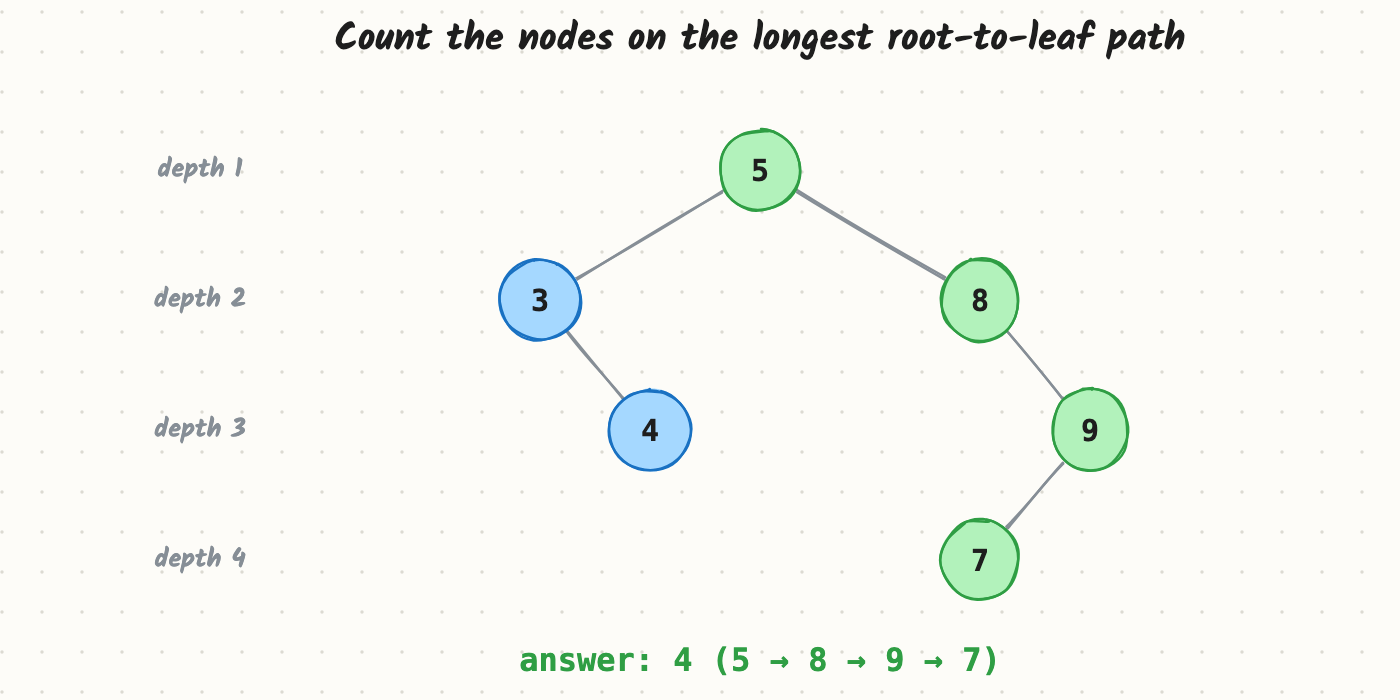
Input:  root = [5, 3, 8, null, 4, null, 9, 7]     # level order, null = missing child
Output: 4                                          # 5 -> 8 -> 9 -> 7
Input: root = [] -> 0
Input: root = [1] -> 1Constraints (assumed)
- 0 ≤ number of nodes ≤ 10⁵ (the tree may be very unbalanced).
What this question tests
- Writing a recursive function with the right base case.
- Knowing the iterative alternatives (BFS by levels, DFS with a stack).
- Thinking about recursion depth on skewed trees.
Questions to ask first
- Depth in nodes or in edges? (Here: nodes, so a single root is 1.)
- What should an empty tree return? (Here: 0.)
- How deep can the tree be? A 10⁵-node chain affects the choice between recursion and iteration.
- Is it a binary tree, or can nodes have many children? (Here: binary.)
Try it yourself first
You have the full problem. Sketch your answer, then sign up free to read the complete walkthrough.
- The complete design, flow by flow, with pictures
- Deep dives into the hard parts
- What mid, senior and staff candidates are expected to say
- Full company question lists
Free forever. No card needed.