Sliding Window Maximum
On this page
Problem statement
Given an array of integers
numsand a window sizek, return the maximum of every contiguous window of lengthk, from left to right. There aren − k + 1windows. A frequent second part: return the length of the longest subarray in which the largest and smallest values differ by at mostlimit.
This is the problem that introduces the monotonic deque, a structure that keeps "the best candidate so far" while items both enter and leave. Once you know it, the second part (a variable-size window that needs both its max and its min) takes a few extra lines. Original problems: LeetCode 239 and LeetCode 1438.
Example
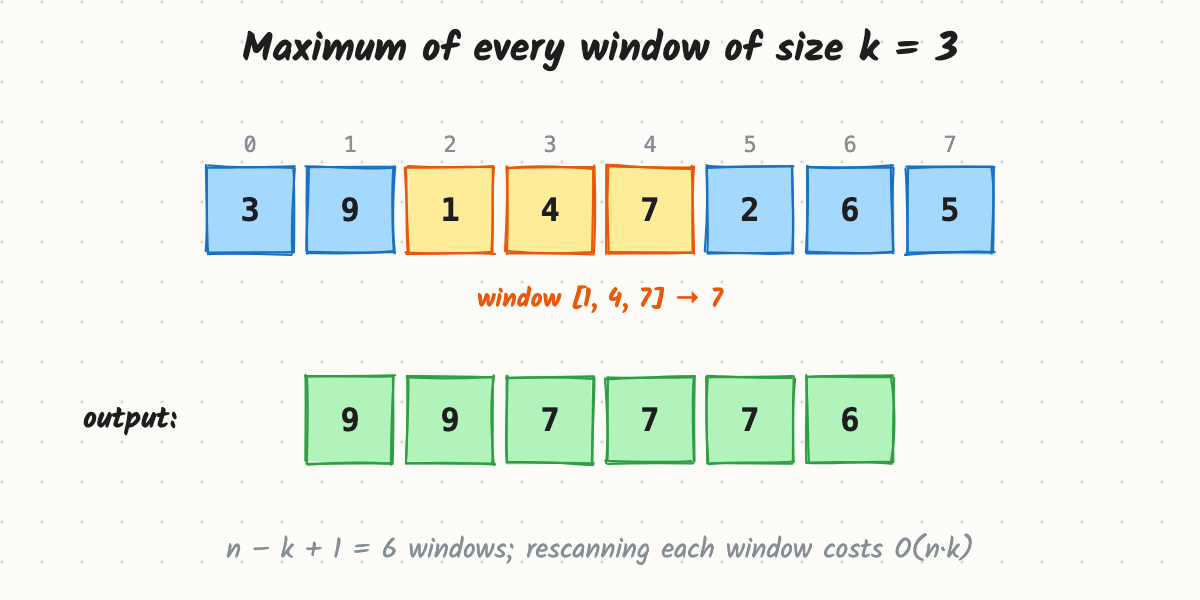
Input:  nums = [3, 9, 1, 4, 7, 2, 6, 5], k = 3
Output: [9, 9, 7, 7, 7, 6]
Part 2
Input: nums = [6, 2, 4, 9, 7, 8, 3], limit = 2
Output: 3 # [9, 7, 8]: max 9, min 7Constraints (assumed)
- 1 ≤ k ≤ n ≤ 10⁵.
- −10⁴ ≤ nums[i] ≤ 10⁴; values may repeat.
What this question tests
- Seeing why a plain sliding window (add one, remove one) fails for max: removing the current max loses information.
- The monotonic deque: which elements can be thrown away for good, and why each is pushed and popped at most once.
- Index bookkeeping: knowing when the front has left the window.
Questions to ask first
- Can
kbe larger thann? (Here: no, 1 ≤ k ≤ n.) - Are there duplicates? They decide whether you pop on
<or≤; both work if you store indices. - Is the input a fixed array or a stream? The deque works for streams too.
- For part 2, is the limit inclusive? (Here: max − min ≤ limit.)
Try it yourself first
You have the full problem. Sketch your answer, then sign up free to read the complete walkthrough.
- The complete design, flow by flow, with pictures
- Deep dives into the hard parts
- What mid, senior and staff candidates are expected to say
- Full company question lists
Free forever. No card needed.