Merge Intervals
On this page
Problem statement
Given a list of intervals, merge every group of overlapping intervals and return the result. Each interval is a pair
[start, end]withstart ≤ end. Two intervals overlap if they share at least one point, so[1, 3]and[3, 5]merge into[1, 5]. The input is not sorted.
You'll meet this problem directly, and even more often in disguise: merging calendar busy times, combining IP address ranges, or collapsing log time windows. Original problem: LeetCode 56.
Example
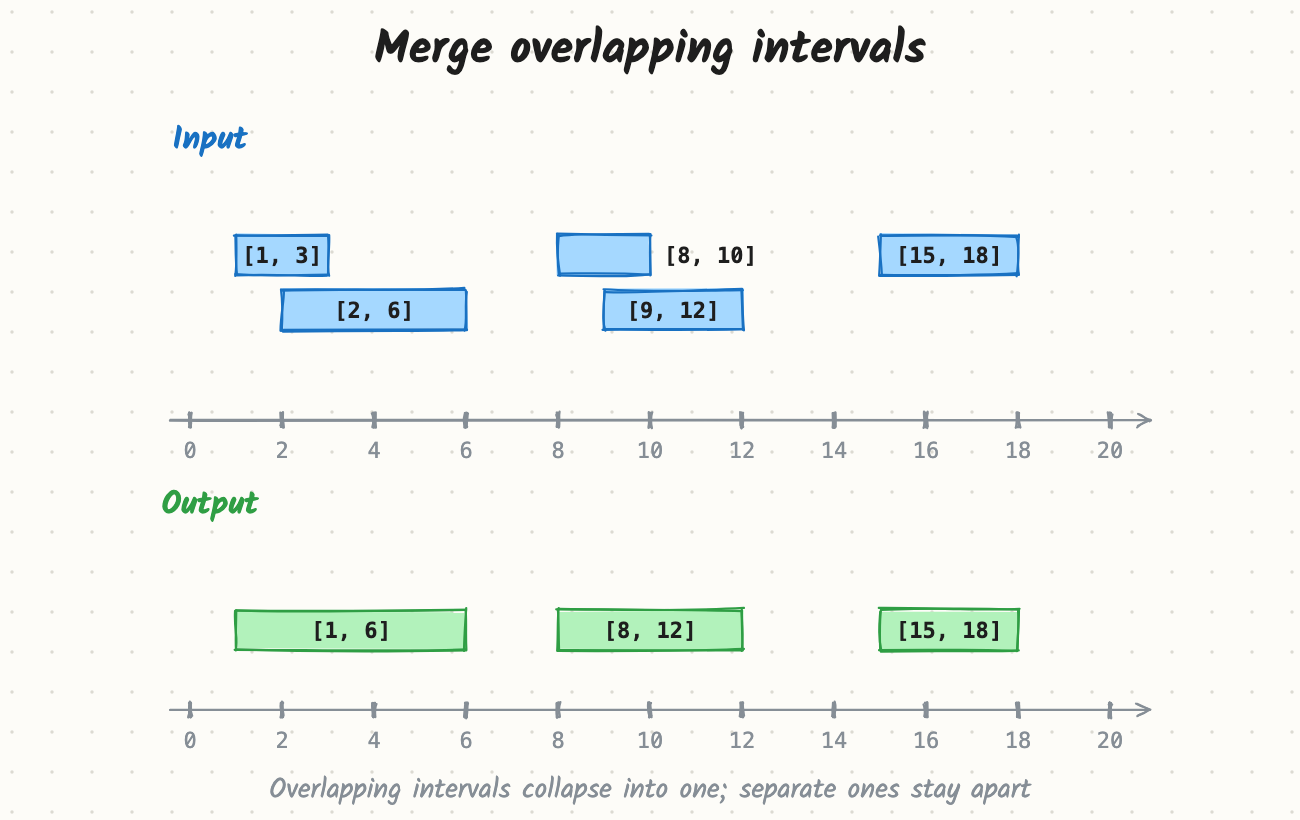
Input:  [[8,10], [1,3], [15,18], [2,6], [9,12]]
Output: [[1,6], [8,12], [15,18]]
Input: [[1,4], [4,5]]
Output: [[1,5]] # touching endpoints count as overlapConstraints (assumed)
- 1 ≤ n ≤ 100,000 intervals.
- 0 ≤ start ≤ end ≤ 10⁹.
What this question tests
- Seeing that sorting turns a messy all-pairs problem into a simple left-to-right scan.
- Getting the overlap condition and the merged end exactly right, including the containment case.
- Clean code and a clear complexity argument.
Questions to ask first
- Do touching intervals merge? Is
[1, 3]with[3, 5]one interval or two? (Here: they merge.) - Is the input sorted? (Here: no.)
- Can I modify the input, or must I return a new list?
- Are intervals closed
[a, b]or half-open[a, b)? This changes the overlap test from≤to<.
Try it yourself first
You have the full problem. Sketch your answer, then sign up free to read the complete walkthrough.
- The complete design, flow by flow, with pictures
- Deep dives into the hard parts
- What mid, senior and staff candidates are expected to say
- Full company question lists
Free forever. No card needed.