Implement an In-Memory Key-Value Store
On this page
Problem statement
Build an in-memory key-value store, one level at a time. Every call receives the current time
nowas an integer, so the store never reads a clock.
Level 1. set(key, value, now), get(key, now) (the value, or None if missing) and delete(key, now) (returns whether the key existed). Level 2. set takes an optional ttl: the key lives while now < set_time + ttl and then behaves as if it was never there. Level 3. begin(), commit() and rollback(), with nested transactions. Reads inside a transaction see its own writes. commit and rollback act on the innermost open transaction and return False if there is none. Level 4. snapshot(now) saves the live data and returns an id; restore(id, now) brings it back. A key that had 6 seconds left when saved has 6 seconds left after the restore.
This is the most common "practical" coding round: a small system built in stages, where each level adds a requirement and the interviewer watches how well your earlier code absorbs it. The wording changes from company to company (a command interpreter, a store with expiry, a store with transactions or backups), but the core is the same. There's no single LeetCode original; the closest pieces are Time Based Key-Value Store and LRU Cache.
Example
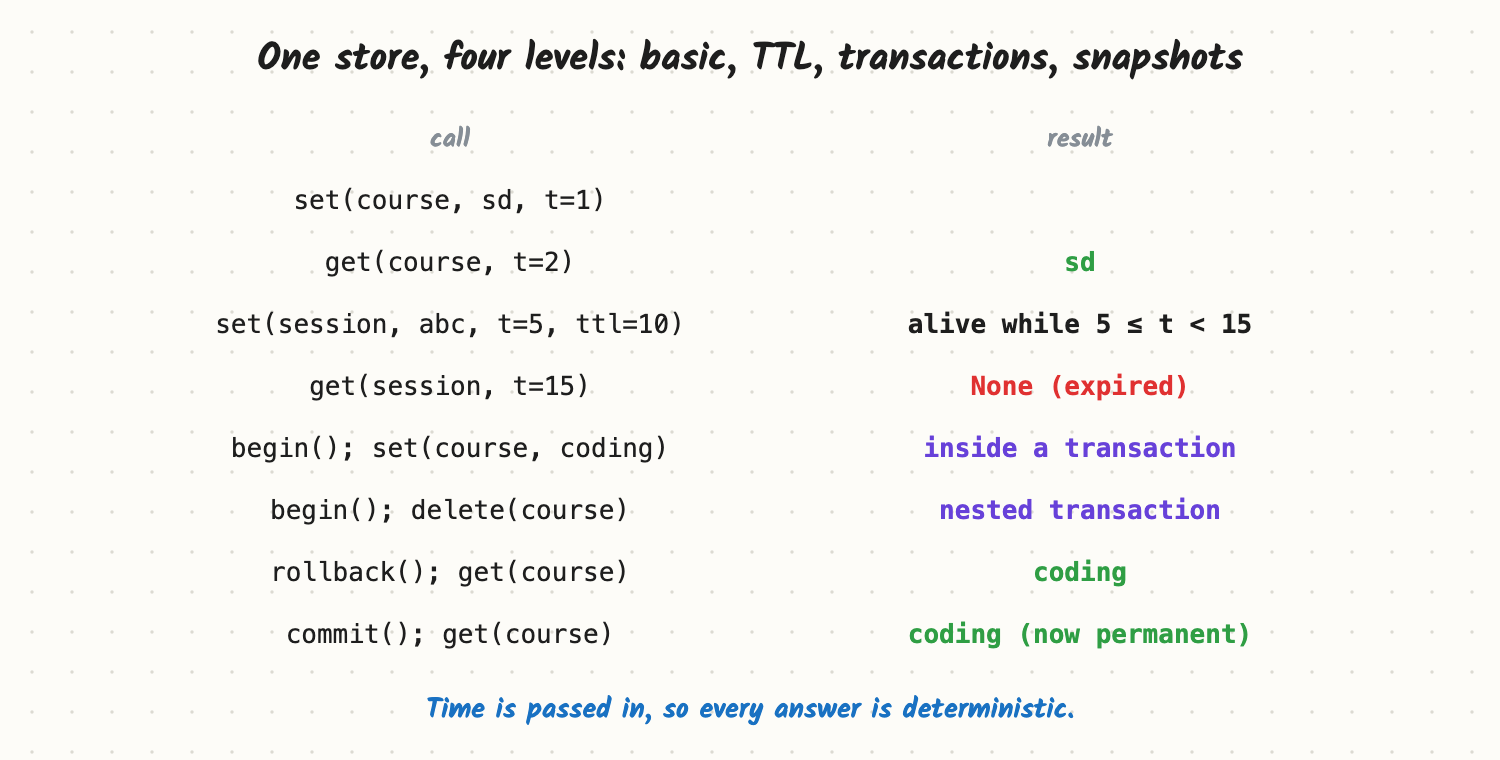
set("course", "sd", now=1)
get("course", now=2)                     -> "sd"
set("session", "abc", now=5, ttl=10)     # alive for 5 <= now < 15
get("session", now=14)                   -> "abc"
get("session", now=15)                   -> None
begin(); set("course", "coding", now=20)
begin(); delete("course", now=21)        -> True
get("course", now=22)                    -> None
rollback(); get("course", now=23)        -> "coding"
commit();   get("course", now=24)        -> "coding"
rollback()                               -> False   # nothing open
set("token", "t1", now=30, ttl=10)
id = snapshot(now=34) # token has 6 s left
delete("token", now=35)
restore(id, now=100)
get("token", now=105) -> "t1"
get("token", now=106) -> None # 100 + 6Constraints (assumed)
- Up to 10⁵ calls; keys and values are strings.
nownever decreases between calls.snapshotandrestoreare only called when no transaction is open.
What this question tests
- Choosing a representation that later levels don't force you to rewrite.
- Getting expiry boundaries and deletes inside transactions exactly right.
- Clean, well-named code written quickly, with tests you run as you go.
Questions to ask first
- Who supplies the time? Passing
nowin makes tests deterministic. (Here: it's passed in.) - Is a key alive at exactly
set_time + ttl? (Here: no, it expires at that instant.) - Does
seton an existing key reset its TTL? (Here: yes, a set replaces value and expiry together.) - Does
commitclose one transaction or all of them? (Here: the innermost one only.) - Must expired keys free memory right away, or is it enough that reads never return them?
Try it yourself first
You have the full problem. Sketch your answer, then sign up free to read the complete walkthrough.
- The complete design, flow by flow, with pictures
- Deep dives into the hard parts
- What mid, senior and staff candidates are expected to say
- Full company question lists
Free forever. No card needed.