Construct Binary Tree from Preorder and Inorder Traversal
On this page
Problem statement
Given two integer arrays
preorderandinorderthat are the preorder and inorder traversals of the same binary tree with distinct values, rebuild and return the tree. A common warm-up in the same round: build a tree from a level-order list such as[8, 3, 10, 1, 6, null, 14], then return its preorder traversal.
This problem tests whether you really understand what each traversal order tells you, not just how to write it. Preorder tells you which node is the root; inorder tells you which nodes are on each side of it. Original problem: LeetCode 105.
Example
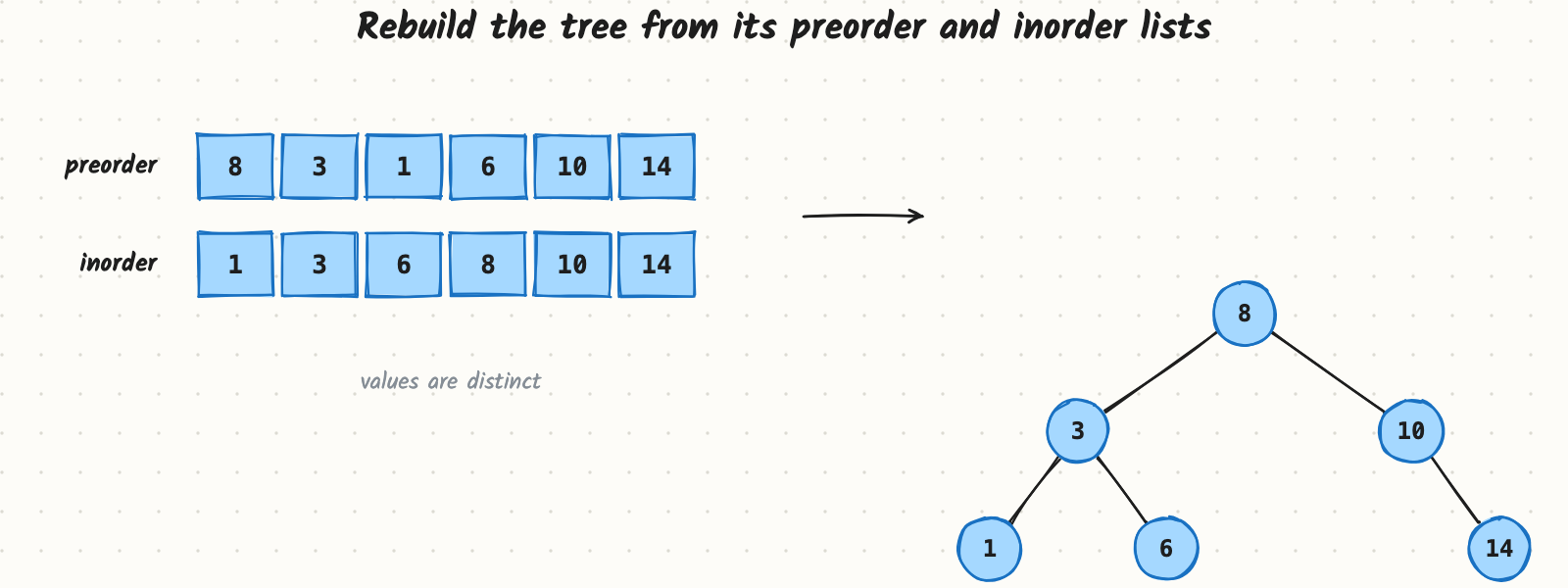
Input:  preorder = [8, 3, 1, 6, 10, 14]
        inorder  = [1, 3, 6, 8, 10, 14]
Output: [8, 3, 10, 1, 6, null, 14]       # the tree, in level order
Input: preorder = [5], inorder = [5]
Output: [5]Constraints (assumed)
- 1 ≤ n ≤ 3,000; all values are distinct.
- Both arrays describe the same valid tree.
What this question tests
- Knowing what preorder (root first) and inorder (left, root, right) each reveal.
- A clean divide-and-conquer recursion over index ranges, without copying subarrays.
- Spotting the O(n²) trap (searching inorder each time) and fixing it with a hash map.
Questions to ask first
- Are the values distinct? With duplicates the tree is not uniquely determined. (Here: distinct.)
- Are the inputs guaranteed to be consistent? (Here: yes; otherwise you'd validate.)
- How deep can the tree be? A 3,000-node chain means 3,000 levels of recursion.
- What should be returned: the root, or a serialised form? (Here: the root.)
Try it yourself first
You have the full problem. Sketch your answer, then sign up free to read the complete walkthrough.
- The complete design, flow by flow, with pictures
- Deep dives into the hard parts
- What mid, senior and staff candidates are expected to say
- Full company question lists
Free forever. No card needed.