Jump Game
On this page
Problem statement
You start at index 0 of an array of non-negative integers. Each value is the longest jump you may take from that position (any shorter jump is also allowed). Return whether you can reach the last index.
A short question with a one-variable greedy answer. Interviewers like it because the DP answer works too, and they want to hear why the greedy one is enough. Original problem: LeetCode 55.
Example
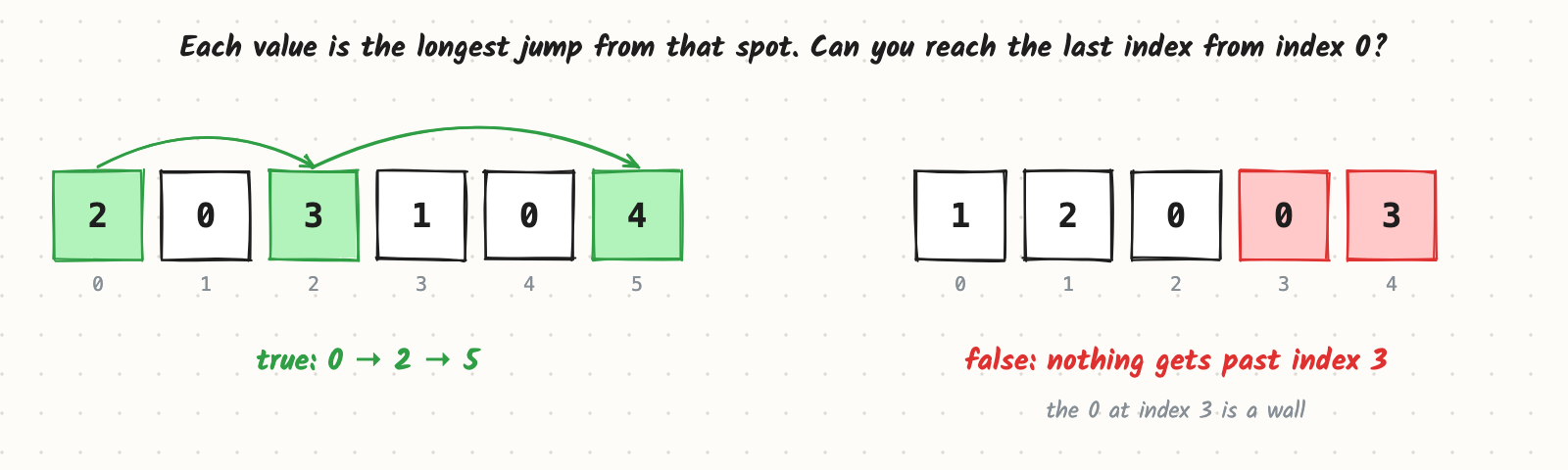
Input:  [2, 0, 3, 1, 0, 4]
Output: true        # 0 → 2 → 5
Input: [1, 2, 0, 0, 3]
Output: false # farthest reachable index is 3Input: [0]
Output: true # already at the last indexConstraints (assumed)
- 1 ≤ n ≤ 10⁴.
- 0 ≤ value ≤ 10⁵.
What this question tests
- Seeing that the set of reachable indices is always a prefix
0..reach, so one number describes it. - Arguing why greedy is correct instead of guessing.
- Knowing the O(n²) DP and why it isn't needed.
Questions to ask first
- Is the value the exact jump length or the maximum? (Here: the maximum; shorter jumps are allowed.)
- Can values be negative? (Here: no.)
- Do you want yes/no, or the fewest jumps? The second is Jump Game II.
- Is a single-element array already at the end? (Yes.)
Try it yourself first
You have the full problem. Sketch your answer, then sign up free to read the complete walkthrough.
- The complete design, flow by flow, with pictures
- Deep dives into the hard parts
- What mid, senior and staff candidates are expected to say
- Full company question lists
Free forever. No card needed.