Cold Start
On this page
A new user opens the app for the first time. The recommender has nothing: no watch history, no likes, no ID embedding worth anything. Meanwhile a creator uploads a video that has zero views; the ranker has never seen its ID, so its learned features are blank. If the system handles these cases badly, new users leave in their first session and new creators stop uploading. Both are the people a platform most needs to keep.
That is the cold-start problem, and it comes up in nearly every recommendation interview, usually as "what about new users?" right after you finish describing your personalised model.
How it works
Three kinds of cold start
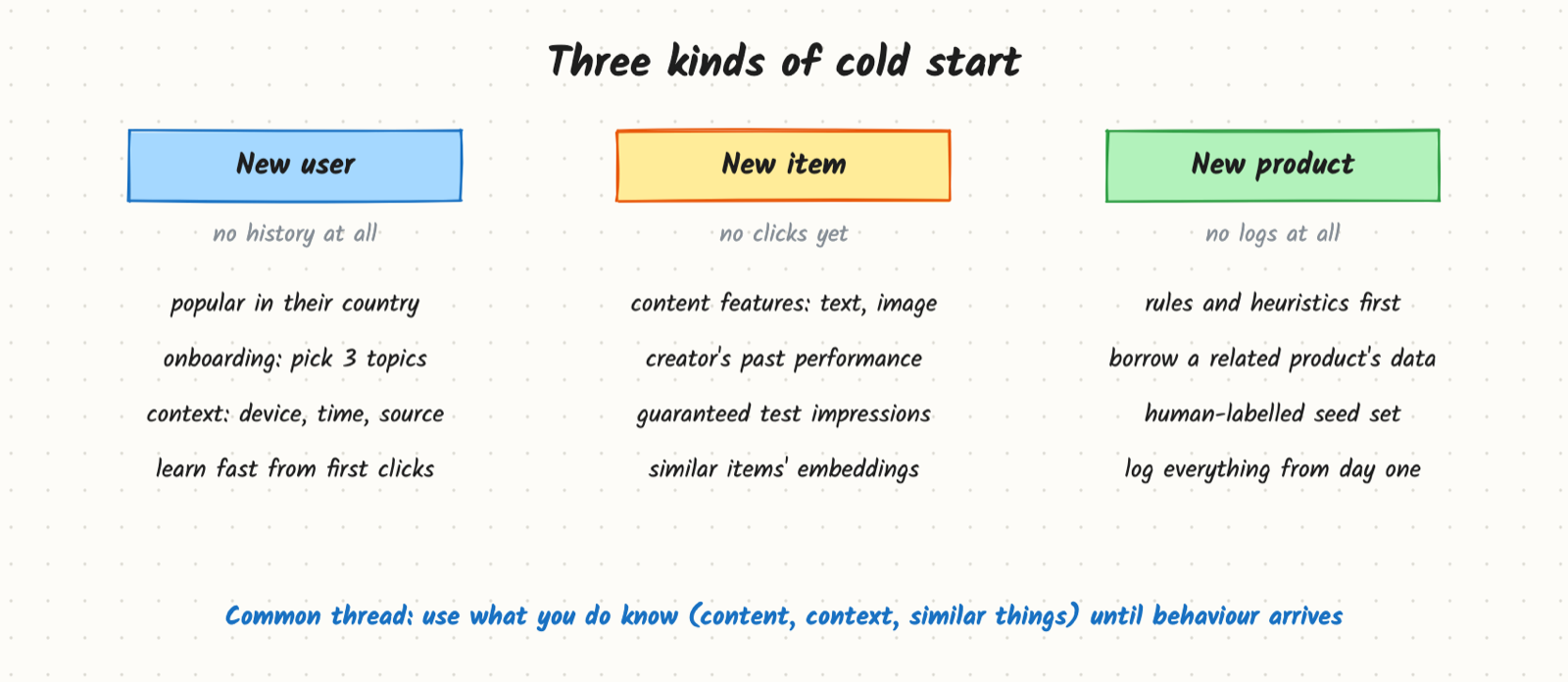
New users have no history. Use what you do know:
- Context: country, language, device, time of day, and how they arrived (a shared link to a cooking video is a strong hint).
- Popular and trending items in their region, which are a solid baseline.
- Onboarding: ask them to pick a few topics or creators. Three taps give more signal than a week of guessing.
- Learn fast: update the user's embedding from their first clicks within the session, not tomorrow's batch. A sequence model over the session's events works even with no long-term history.
New items have no interactions. Use:
- Content features: text, image and audio embeddings from pretrained encoders, category, length, language. A two-tower item tower built on these can embed a new item the moment it is uploaded.
- Creator or seller features: the track record of whoever made it.
- Guaranteed exploration: give each new item a small budget of impressions to people likely to be interested (by content similarity), then let its real engagement decide.
A new product or market has no logs at all. Start with rules and heuristics, borrow data or models from a related product, label a small seed set by hand, and log everything from the first day so the first model can be trained a few weeks later.
Handing over from general to personal
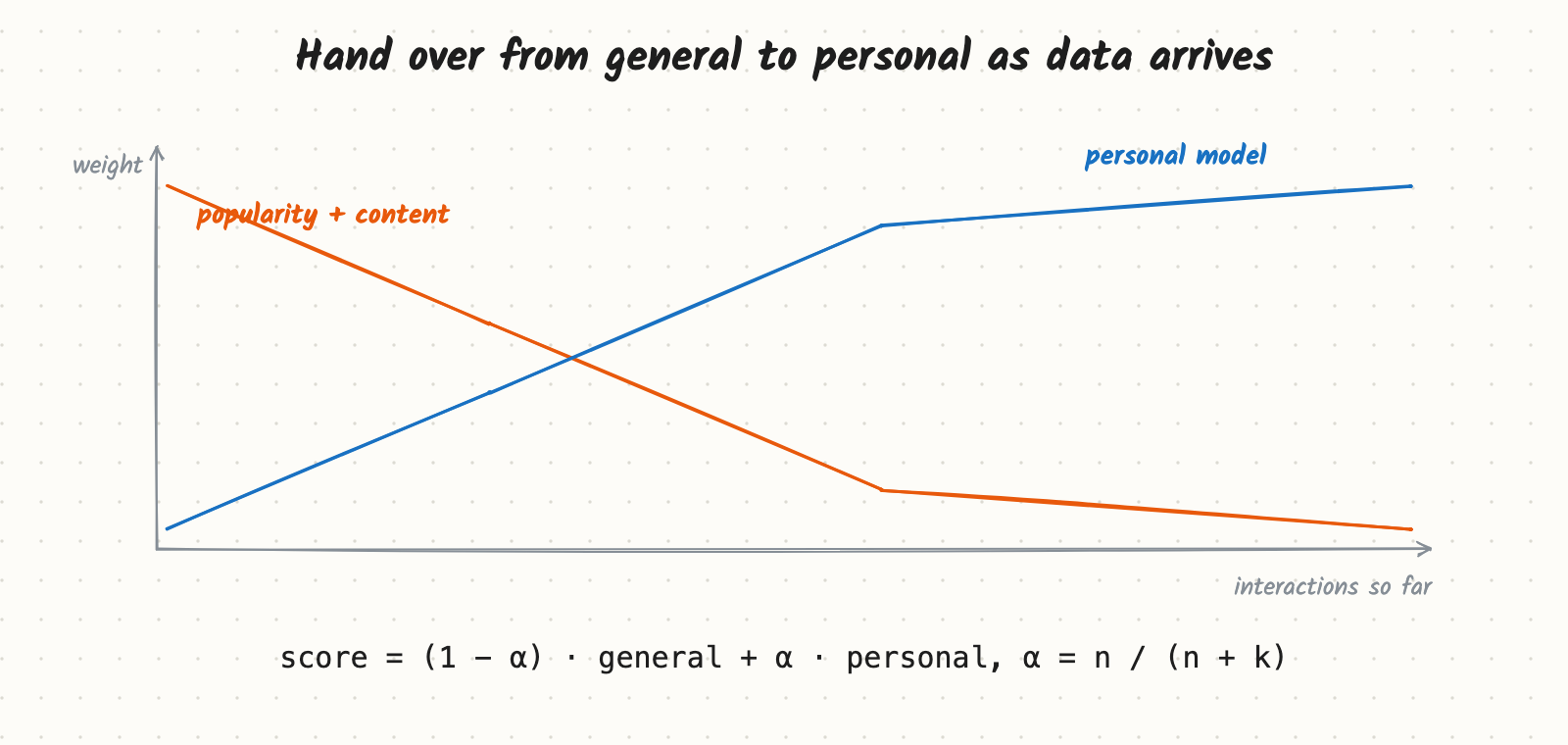
Rather than switching models at an arbitrary point, blend them:
score = (1 − α) · general_score + α · personal_score, α = n / (n + k)where n is the number of interactions so far and k sets how quickly to trust personal data (for example k = 20). In practice, a single ranking model often does this on its own if it gets features like "number of interactions so far" and both content and ID features: it learns to rely on content when IDs are uninformative. The explicit blend is a clear way to explain it in an interview.
Smoothing early statistics
A new item with 1 view and 1 like has a 100% like rate. Never rank on raw early rates; use a smoothed estimate:
smoothed_rate = (likes + prior_rate × m) / (views + m)With a prior like rate of 4% and m = 100, that new item scores (1 + 4) / (1 + 100) ≈ 5%, a little above average, until more views arrive.
Trade-offs and costs
- Exploration impressions cost engagement. Every impression given to an unproven item is taken from a proven one. Cap the budget per item and target it by content similarity.
- Onboarding friction. Asking questions helps the model but some users skip or leave. Keep it to one screen and make it optional.
- Content features versus ID features. Content features generalise to new items but capture taste less precisely than learned IDs. Use both; the model weights them by how much data an item has.
- Fast session updates need streaming infrastructure; daily batch updates are simpler but leave new users with a generic feed for their whole first day.
When to reach for it
Every recommendation and ranking problem, usually as a deep dive after the main design: video, products, people you may know, ads (new advertisers and new creatives), marketplaces (new listings, new sellers). Also when a design relies heavily on ID embeddings: name cold start as the weakness before the interviewer does.
Example
Prompt: "Design a video recommendation system." Cold start plan:
- New user, first session: retrieval from popular-in-country, trending, and an onboarding topic picker; the ranker uses context features and the topic picks. After each video watched, the session sequence model updates the user vector, so the third video is already personalised.
- New video: the item tower embeds it from title, thumbnail, audio and creator features within minutes of upload, so it can be retrieved. It gets up to 1,000 exploration impressions to users whose interests match its content; after that, its smoothed watch rate decides.
- New creator: creator features fall back to their category's average, with a small boost for first uploads.
- Metrics: day-1 and day-7 retention for new users; share of new videos that reach 1,000 views within 48 hours.
Common mistakes
- Only ID embeddings, so new items and users get random vectors.
- Ranking on raw early rates, which puts lucky new items at the top.
- Treating "no data" as "bad", so new items never get impressions.
- A generic feed for a new user's whole first day because personalisation updates only in nightly batch.
- No metric for the cold-start population, so the overall average hides how bad the first session is.
Say this in the interview
"For a new user I'd lean on context, popular-in-region and a quick topic picker, and update their vector from each video they watch in the session. For a new video, the item tower uses content features, so it's retrievable minutes after upload, and it gets a capped exploration budget to matching users before its smoothed engagement decides. I'd track new-user retention and how fast new videos reach their first thousand views."
Used in
- Before this: Feedback Loops, Position Bias and Exploration
- Next: start the problems with Design a Spam Email Classifier
- Related: Two-Tower Models and Vector Search, Features and Embeddings
- Problems: Design a Video Recommendation System, Design E-commerce Product Recommendations, Design People You May Know, Design Ad Click Prediction